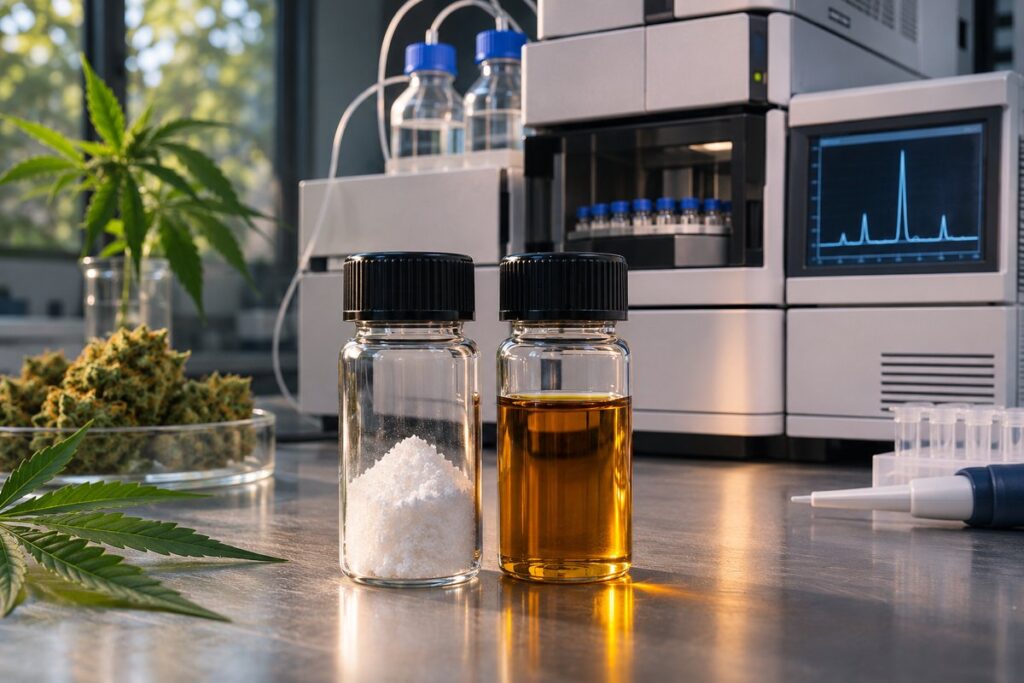
Two bottles each promise 500 milligrams of cannabidiol. One also says “full spectrum,” the other “CBD isolate.” Measuring exactly 500 milligrams in both would settle the question printed in numbers. It would leave the question printed in words almost untouched. A study of how consumers interpret hemp oil names approached these terms from the reader’s side of the label. To investigate those words chemically, a laboratory needs to know what else is in the bottles, which compounds its instruments can recognize, and how small a signal it can reliably distinguish from the background.
Giving the words a laboratory meaning
Barry Gidal and colleagues faced that problem in a 2024 study of 202 commercial CBD products. The sample included tinctures, gummies, vapes and topical preparations. Some packages claimed to contain full-spectrum or broad-spectrum extracts, some specified isolate, and others offered no such description. A spectrum claim had to be translated into a rule before the analysts could decide whether the contents met it.
For a full-spectrum claim, the study looked for CBD, THC and at least one other cannabinoid produced by the plant. Its broad-spectrum definition required CBD and another plant cannabinoid with no detectable THC. For isolate, the investigators used a purity criterion of greater than 95 percent CBD. That last percentage describes the isolate ingredient. A bottle of carrier oil made with isolate can be mostly oil by weight.
These were operational definitions chosen for the investigation. They make it possible to repeat the comparison and to ask what would happen under a different rule. A laboratory searching only for CBD and THC could never satisfy the three-compound test for full spectrum, however many other cannabinoids its sample actually contained. A short list on a certificate can reflect a short list of measurements.
What counts as a missing peak?
The team separated and measured cannabinoids by liquid chromatography with a diode array detector. In a simple picture of the output, a compound gives a peak as it passes the detector. Analysts use reference materials and quality controls to decide what a signal represents and how much material produced it. A well-resolved peak from an abundant compound is an easier call than a trace signal in a complicated mixture.
Suppose two laboratories test portions from one bottle. One reports a trace of THC. The other reports that THC was below its reporting limit. Those statements can be compatible if the trace falls between what the two methods can report. A reader who silently replaces “below the limit” with zero turns an analytical qualification into a much stronger claim. NIST’s laboratory quality-assurance program compares cannabinoid results across laboratories, a practical way to examine how comparable measurements really are.
Composition and quantity get separate verdicts
A sample can have the collection of cannabinoids expected of a full-spectrum extract and still contain far less CBD than the package promises. Conversely, a bottle can contain the advertised milligrams of CBD without the minor cannabinoids its description leads a customer to expect. Gidal’s team evaluated the spectrum claims separately from the numerical CBD claims. For the latter, 53 of the 202 products fell within ten percent of the stated amount. That count describes agreement on CBD quantity across the study sample.
An earlier investigation of extracts bought online also checked measured CBD against the label. Its question about quantity remains relevant to an isolate, a broad-spectrum product or an unclassified bottle alike. To understand a particular result, the most revealing details are often mundane: the units, the tested batch and the names of the compounds the laboratory included.
The chemical profile can provide good evidence that a sample fits a stated definition. Recovering the manufacturer’s entire process from that profile would be a much larger undertaking. A peak shows that a detectable substance was present in the submitted material. It cannot, by itself, tell the history of every ingredient that went into the bottle.